GenAI-Augmented ETL Data Pipeline
Role: Data / AI Engineer
Client: A data-driven enterprise
The Challenge
The client's data pipeline was struggling with unmanaged data sources, scalability limits, and high data latency, while brittle error handling and heavy manual intervention made every incident a fire drill.
The Solution
- Rebuilt ingestion on AWS Glue and Amazon Kinesis for reliable batch and streaming data
- Added enrichment, transformation, cleansing, and labeling stages to the pipeline
- Introduced queue-based orchestration to coordinate complex, multi-step workflows
- Applied LLM contextual intelligence for context-aware data transformation
- Used semantic understanding for intelligent schema mapping across sources
- Let models generate new fields and append external datasets based on patterns in the data
- Built error handling with self-healing recovery to reduce manual intervention
Key Outcomes
Technologies Used
Overview
A data-driven enterprise depended on an ETL pipeline that had outgrown its original design. New sources kept getting bolted on without a consistent ingestion pattern, throughput couldn’t keep up with demand, and data arrived too late to be useful. When something broke, recovery was manual and slow. We were brought in to modernize the pipeline and fold in GenAI where it could do real work — not as a demo, but as part of the plumbing.
The Challenge
The existing pipeline had a familiar set of problems that compounded each other:
- Unmanaged data sources with no consistent ingestion contract
- Scalability challenges as data volume grew beyond what the design could handle
- Data latency that made downstream analytics stale
- Error handling and recovery issues that turned failures into manual firefighting
- Manual intervention at nearly every stage, with little automation
Each new source made the system more fragile. The goal was a pipeline that could scale, self-correct, and reason about the data it moved.
Solution: GenAI-Augmented Pipeline
We kept a clean separation between reliable data infrastructure and the GenAI layer that made it smarter, so the LLM-driven pieces enhanced the pipeline rather than becoming a single point of failure.
Ingestion & Processing
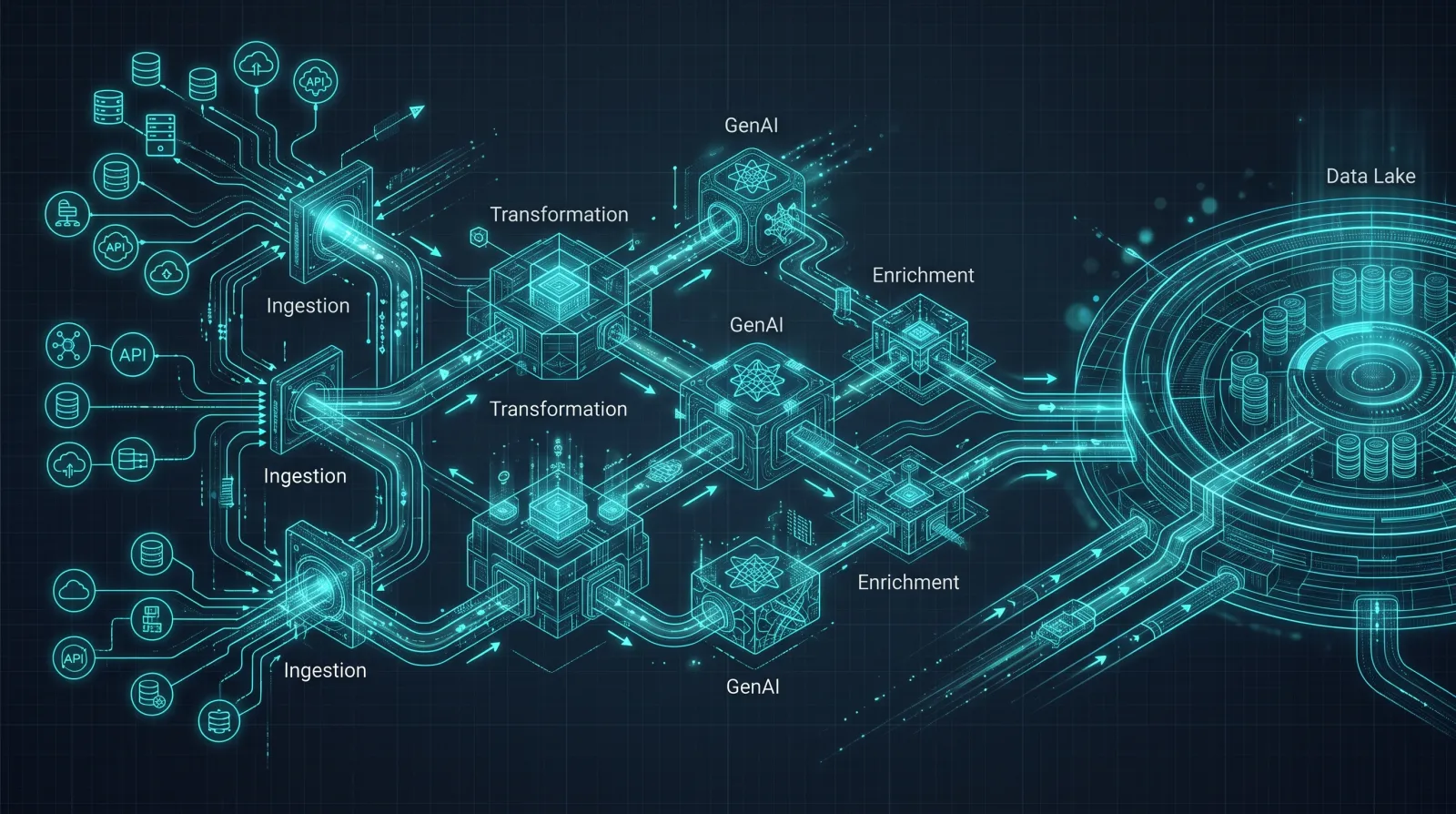
We rebuilt ingestion on AWS Glue for managed batch ETL and Amazon Kinesis for streaming data, giving every source a consistent entry point. On top of ingestion, we added enrichment, transformation, cleansing, and labeling stages so data was cleaned and structured before it reached downstream systems. Queue-based orchestration coordinated the more complex, multi-step workflows and kept stages decoupled.
Context-Aware Transformation
Rather than hand-code every transformation rule, we used LLM contextual intelligence to handle transformations that depend on meaning, not just structure. The model interprets the surrounding context of a record and applies the right transformation, which covered cases that rigid rules had always struggled with.
Intelligent Schema Mapping
Mapping fields across mismatched sources was one of the biggest manual costs. We introduced semantic schema mapping, using embeddings and language understanding to align fields by meaning rather than exact names. The models could also generate new fields or append external datasets based on patterns already present in the data.
Self-Healing Error Recovery
We replaced brittle error handling with a recovery layer designed to self-heal. Instead of halting and waiting for a human, the pipeline detects failures, retries or reroutes where it can, and only escalates when it genuinely needs a person — sharply reducing manual intervention.
Impact
The source engagement measured impact qualitatively, and the gains showed up as capability rather than a single headline number:
- Operational efficiency improved as manual steps gave way to automated, orchestrated workflows
- Data quality rose through consistent enrichment, cleansing, and labeling
- Consistency and integrity across sources became far easier to maintain
- Ingestion and processing grew more reliable and scalable, with lower latency
- Error recovery shifted from manual firefighting to self-healing behavior
Key Learnings
The most durable lesson was to treat GenAI as one component in a larger system. The wins came from putting Glue, Kinesis, and queue-based orchestration underneath — solid, boring infrastructure — and applying LLMs only where semantic understanding earned its place: transformation, schema mapping, and field generation. Keeping that boundary clean is what made the pipeline both smarter and more dependable.
Interested in similar results?
Let's discuss how I can help your organization achieve its goals.
Get in Touch