Cloud-Native Migration for a Data-Extraction Platform
Role: Cloud Solutions Architect
Client: A web-scraping & data-extraction company
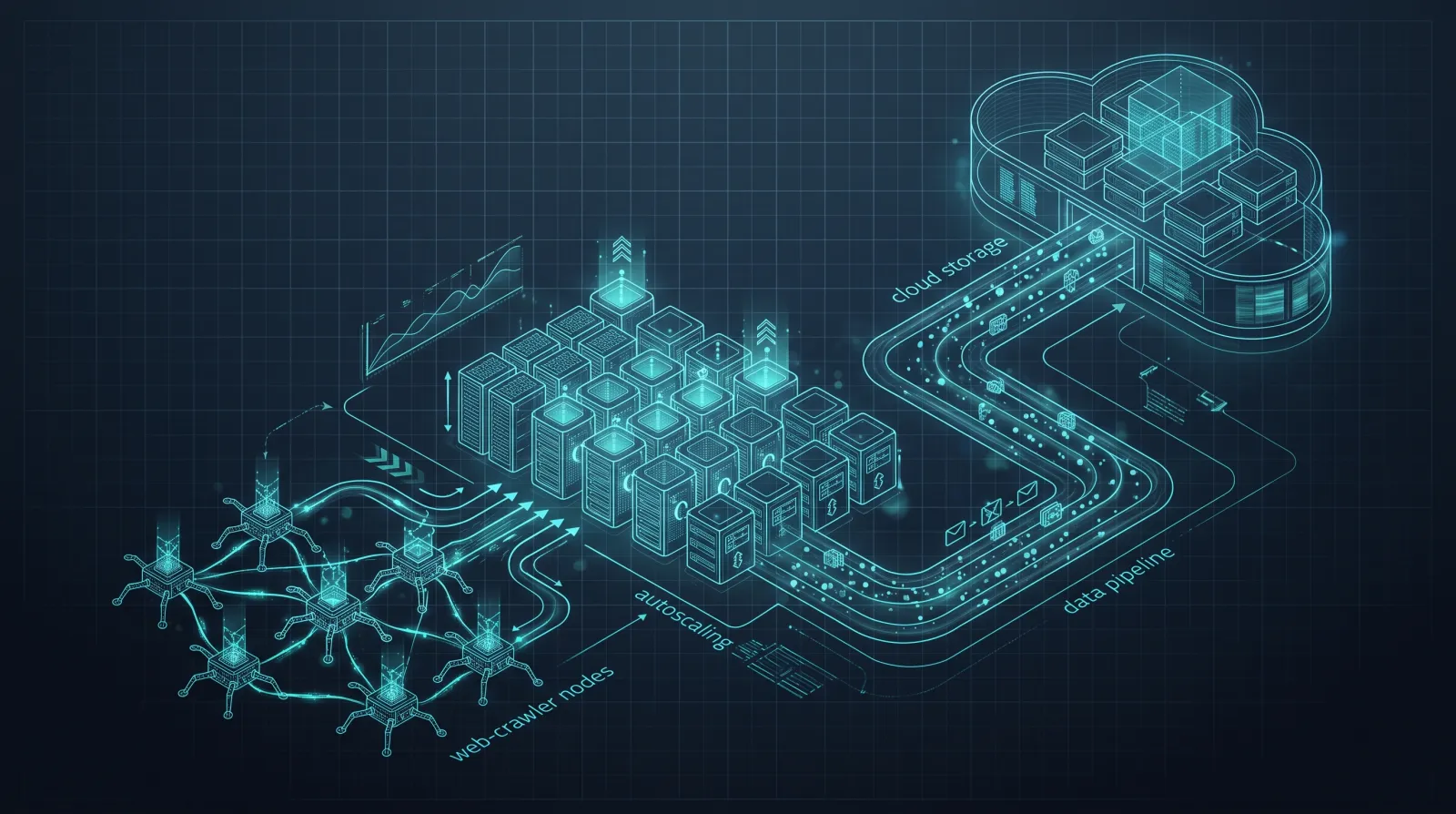
The Challenge
The client's on-premises legacy infrastructure couldn't scale with a surging customer base, driving cost overruns, weak observability and security, and slow manual CI/CD. Peak-time scraping jobs degraded, SLAs slipped, and manual patching and provisioning drained engineering time.
The Solution
- Migrated compute to EC2 Auto Scaling backed by Golden AMIs baked with Packer and Ansible for reproducible, self-healing capacity
- Moved persistence to RDS PostgreSQL Multi-AZ with automated failover, and layered EFS for shared file access with S3 for durable, low-cost object storage
- Built a secure network with ALB across AZs, Route 53 DNS failover, and NAT Gateway for private-subnet egress
- Codified every environment (dev, stage, prod) in Terraform for version-controlled, repeatable provisioning
- Automated build, test, AMI creation, and deploy with GitHub Actions, embedding SonarQube static analysis and OWASP ZAP dynamic scanning plus GitHub SHA rollbacks
- Instrumented observability with CloudWatch, X-Ray tracing, and VPC Flow Logs, and hardened the platform with Security Hub, WAF, Inspector, and Prowler against CIS Benchmarks, with CUDOS, Budgets, and Cost Explorer driving FinOps
Key Outcomes
Technologies Used
Project Overview
The client is a data-extraction company that ships high-performance web-scraping tools for data-driven decision-making. As demand climbed, their on-premises infrastructure stopped keeping up. Physical servers couldn’t absorb growing customer workloads, and the result was performance bottlenecks, high maintenance costs, and operational drag that pulled engineers away from building the product.
I led a lift-and-shift migration to a cloud-native architecture on AWS, then optimized it with scalable compute and storage, automated CI/CD, and a security and cost-governance layer. The goal was straightforward: let the platform scale with its customers instead of fighting its own infrastructure. We ran the engagement over five months and moved the entire operation to AWS.
Key Challenge: Outgrowing Legacy Architecture
The legacy stack ran on physical servers that were never going to keep pace with a rapidly growing customer base and rising data volume. A few problems compounded each other:
- Scalability limits — The platform couldn’t scale past a fixed number of concurrent scraping jobs. During peak ingestion, performance degraded, SLAs slipped, and customers noticed.
- Operational inefficiency — Manual infrastructure management ate hours of engineering time every week that should have gone into new features and data-quality work.
- Thin observability — Without centralized logging and metrics, mean time to detect stretched out, delaying incident response and hurting reliability.
- Cost overruns — Overprovisioned servers sat underutilized. Idle capacity meant real money wasted every month.
- Governance and compliance risk — No automated controls across environments meant misconfigurations could slip through, exposing the company against frameworks like the CIS Benchmarks.
- Deployment bottlenecks — Manual CI/CD added multi-hour delays per release and slowed time-to-market.
- Manual overhead — EC2 patching, credential handling, launch-template updates, and AMI provisioning all needed hands-on oversight. Rollbacks weren’t automated, so recovery from a bad deploy was slow and risky.
- Security gaps — Limited traffic monitoring and no WAF or DDoS protection left the platform open to web exploits and unauthorized access, with weak access controls widening the blast radius of any breach.
Together these issues capped the company’s growth and its ability to deliver reliably. It needed a scalable, cost-effective cloud foundation.
The Solution: Cloud Migration to AWS
I ran a lift-and-shift migration to AWS, then optimized for scalability, automation, and security. Here’s how the pieces fit together.
Compute
EC2 Auto Scaling with Golden AMIs. Capacity adjusts automatically to job load, which is what supported a 30% increase in concurrent scraping jobs without service degradation. I chose horizontal scaling to minimize manual intervention, and baked Golden AMIs with Packer and Ansible so every instance came up predictable and reproducible.
Data & Storage
RDS PostgreSQL in a Multi-AZ configuration handles the database. Automated failover keeps the platform available and data intact during an outage, and the managed setup with automated backup and restore cut administrative overhead. For files, I paired EFS for elastic shared storage across EC2 instances with S3 for durable, low-cost object storage covering archival and analytics.
Networking
An Application Load Balancer spreads scraping traffic evenly across availability zones with automated health checks. Route 53 handles DNS and failover, and a NAT Gateway gives instances in private subnets secure outbound internet access. The result is a fault-tolerant, multi-AZ network.
Infrastructure as Code
Everything is defined in Terraform. Provisioning across dev, stage, and prod is consistent and version-controlled, and its declarative syntax plugged straight into the CI/CD pipelines. Adopting IaC early was the single biggest lever for keeping environments reproducible.
CI/CD
GitHub Actions orchestrates the pipeline: lint, validate, plan, and apply Terraform, then build, test, bake AMIs (Packer and Ansible), and deploy. SonarQube runs static analysis and OWASP ZAP runs dynamic scanning inside the pipeline, so code quality and security checks aren’t an afterthought. Rollbacks are automated and tied to the GitHub SHA. This lifted deployment frequency by 25%.
Observability
CloudWatch, X-Ray, and VPC Flow Logs give visibility across every tier — metrics, logs, alarms, and distributed traces in one place. SNS and CloudWatch Alarms push real-time notifications on health checks, failed scraping jobs, and security anomalies. Together with Slack-integrated alerting, this cut MTTR by 40%.
Security & Compliance
IAM enforces least-privilege access. WAF guards against web exploits. Security Hub, Inspector, and Prowler continuously scan for vulnerabilities and misconfigurations and keep the environment aligned to CIS Benchmarks. Secrets Manager stores and rotates credentials and API keys, injecting them securely during instance bootstrap rather than baking them into images. AWS Backup centralizes recovery across RDS and EFS to meet RTO and RPO targets.
FinOps / Cost Governance
Cost visibility runs through a CUDOS dashboard, AWS Budgets, and Cost Explorer across dev, stage, and prod. Account-level granularity plus budget alerts surfaced the real cost drivers and savings opportunities. Wiring cost awareness into Terraform and GitHub Actions kept deployments cost-conscious by default and helped the client avoid budget overruns.
Results & Metrics
- 20% TCO reduction — Roughly $14.5K/year saved, freed up for R&D and DevOps automation.
- HTTP 5xx errors down 90% — Task completion times improved, and customer satisfaction rose alongside.
- MTTR down 40% — Real-time alerting and distributed tracing turned firefighting into fast, targeted response.
- 30% more concurrent scraping jobs — Auto Scaling expanded service capacity directly, and deployment frequency rose 25% on top of it.
- 99% uptime — Multi-AZ deployments and automated backups held availability steady, with CIS-aligned compliance and centralized visibility through Security Hub reducing audit prep.
Key Learnings
- Adopt IaC early — Terraform from day one gave us consistent, reproducible environments and made every later step easier.
- Automate the pipeline end to end — GitHub Actions cut manual errors and sped up delivery, and automated rollbacks made deploys safe to run often.
- Centralize observability — CloudWatch plus Slack alerting was what made proactive issue resolution possible instead of reactive.
- Build security in, not on — WAF, Security Hub, and CIS-aligned scanning from the start kept compliance risk low rather than deferring it.
- Golden AMIs pay off — Baking images with Packer and Ansible streamlined provisioning and hardened security in one move.
- Plan for high availability — Multi-AZ deployments and disciplined backups were non-negotiable for uptime and recovery.
Interested in similar results?
Let's discuss how I can help your organization achieve its goals.
Get in Touch